




Karnataka to roll out VB G RAM G from 1 July despite cost concerns
Khandre said Karnataka opposed the law, arguing that states were not adequately consulted before the G RAM G was framed.
PTI
.png)
-
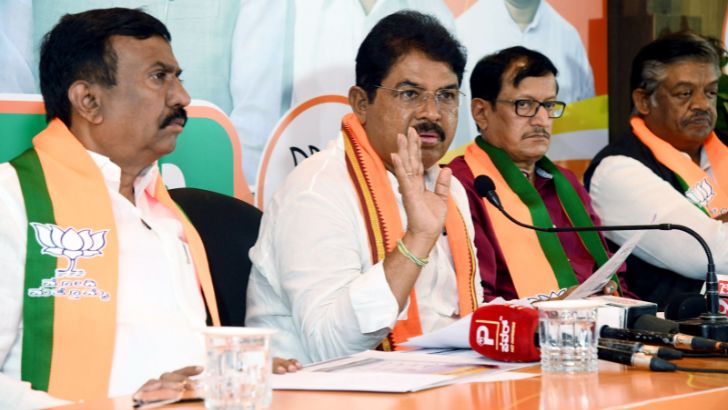
Eshwar Khandre said the Centre had allocated Rs 5,709 crore to Karnataka under VB–G RAM G (X/@eshwar_khandre)
Bengaluru, 24 June
Karnataka Minister Eshwar Khandre on Wednesday said the new rural employment guarantee scheme, VB–G RAM G, which replaces MGNREGA, will be implemented from July 1 despite the additional financial burden on the state government.
The State
rural development and panchayat raj minister said the decision was being taken
in the interest of rural residents, women, marginalised communities and other
vulnerable sections of society.
"Under
the Mahatma Gandhi National Rural Employment Guarantee Scheme introduced by the
UPA government, the Centre previously bore wages in a 90:10 ratio, with states
contributing only 10 per cent," Khandre said.
"Under
the new arrangement, expenses must be shared in a 60:40 ratio, significantly
increasing the burden on state governments," he added.
Speaking
to reporters after chairing a meeting with senior officials here, he said,
"From 2006 to 2026, the Centre spent about Rs 56,492 crore under MGNREGA in Karnataka, while the state contributed only Rs 4,821 crore, generating
around 182 crore person-days of employment."
"Under
the new system, the state alone will have to bear Rs 3,806 crore in a single
year, which is a major financial burden," he added.
Khandre
said the Centre should have consulted the states and taken them into confidence
before introducing the Viksit Bharat–Guarantee for Rozgar and Ajeevika Mission
(Gramin) in Parliament.
He said
the Karnataka government opposed the manner in which the law was framed without
adequate consultation with the states.
The matter
is being challenged in the Supreme Court, and the state is also demanding that
the Centre gradually increase its share to at least 80:20 to support the
states, he said.
Khandre
said the Centre had allocated Rs 5,709 crore to Karnataka under VB–G RAM G.
To ensure
that rural residents do not suffer, the state government will contribute Rs
3,806 crore, he said, adding that he had already submitted a proposal to the
CM, who had approved it.
Criticising
the Centre's directive barring employment under the scheme for 60 days during
the agricultural season, he termed the decision "unscientific and
harmful" to rural families.
"With
the increasing use of modern agricultural machinery, many rural workers are
unable to find employment even during the farming season," he said,
arguing that the restriction effectively deprives them of their livelihood.
The state
government has formally objected to the provision, he said, adding that a
meeting of rural development and panchayat raj ministers from all states,
chaired by the union minister, would be held in Delhi on June 28, where these
concerns would be raised.
Emphasising
that employment should be provided based on demand, Khandre said Karnataka
currently offers a wage of Rs 375 per day.
Since the
state has increased minimum wages, the Centre should revise its wage rates
accordingly, he added.
VB–G RAM G
will come into effect on 1 July, and the government is prepared to employ all
eligible individuals seeking work under the scheme, he said.
Pointing
out that the state had generated 1.40 lakh person-days of employment over the
past three months and had set an annual target of 9 crore person-days, the
minister said the aim was to generate 80–90 lakh person-days every month.
He said
the government would take steps to ensure that the livelihoods of more than
7,000 contractual staff currently working under MGNREGA are not adversely
affected by the transition.
Share Now

Leave a Reply
Your email address will not be published. Required fields are marked *
Other Stories
 (1).png)

.png)
.png)
.png)
.png)
.png)
